

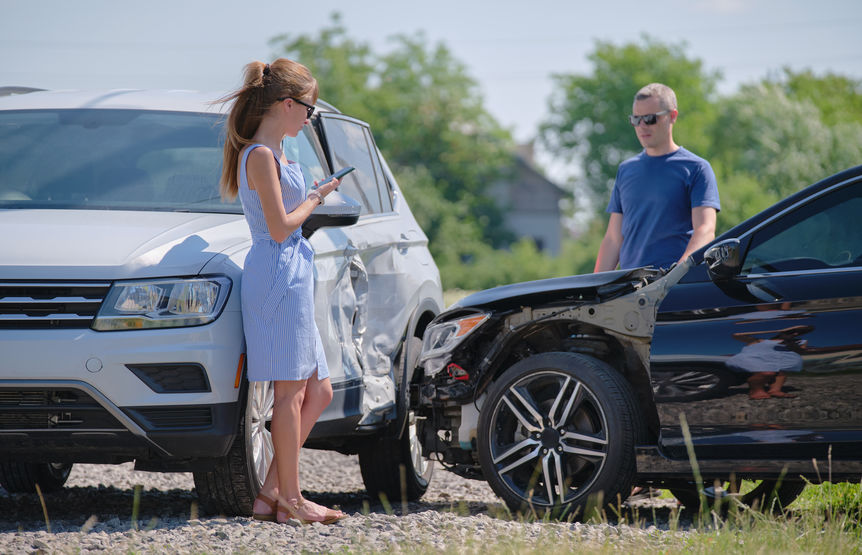
 When a crash happens, photos are usually the first way the scene is recorded. They show vehicle damage, debris on the road, skid marks, and other visual details that help tell part of the story. Photos are helpful, but they do not always capture enough information to fully document a crash site. A point cloud model captures the scene in a much more complete and useful way.
Understanding the difference between photos and a point cloud model can help investigators, attorneys, insurance professionals, and engineers get a clearer picture of what really happened.
What Photos Can Show
Photos are good at capturing select views from specific angles. They can show how badly a vehicle was damaged, where debris landed, and what the scene looked like in general. Investigators often take multiple photos from different angles to capture as much as possible.
The problem is that photos only record what the camera sees. They do not always show distances or spatial relationships with precision. Important details can be hidden by shadows, traffic, or nearby objects. A series of photos can show parts of the scene, but they cannot be easily combined to measure distances or recreate the entire site.
What a Point Cloud Model Captures
A point cloud model is created using scanning technology that collects millions of precise data points across the entire crash site. Each point represents an exact location in three-dimensional space. When all these points are combined, they create a digital model of everything in the scanned area.
This model shows the road surface, vehicles, signs, guardrails, lighting poles, trees, road markings, and any other features that were captured. Because the data is three-dimensional, it can be viewed from any angle and measured directly.
From a point cloud model, investigators can determine how far apart vehicles were, the slope of the road, the exact location of tire marks, and the position of roadside features that might have influenced a crash. This level of detail simply cannot be obtained from photos alone.
Why Point Clouds Matter More Than Photos
Photos are snapshots. They are limited by the photographer’s location, the camera angle, and lighting conditions. A point cloud model provides a full digital record of the scene that can be used well after the physical location has changed.
Crash scenes change quickly. Vehicles are moved, evidence is disturbed, and weather conditions can alter the surface of the road. Once that happens, it is hard to recreate exactly what was there. A point cloud model preserves the details in a way that a photo cannot.
This makes a point cloud model especially valuable when investigations require precise measurements, visibility analysis, or comparison of pre-crash and post-crash conditions.
Point Cloud Models Provide the Complete Picture
Photos are an important part of crash documentation, but they only tell part of the story. A point cloud model captures the whole environment with accurate three-dimensional details that can be measured, analyzed, and revisited as needed.
If you need reliable scene documentation that goes beyond photos, 4N6XPRT Systems offers professional point cloud models and forensic car accident reconstruction software that can help you see what truly happened at a crash site. Our point cloud services provide detailed digital records that are valuable for court, insurance, and technical analysis. Give us a call at (619)464-3478 to learn how our point cloud solutions can support your next case.